


It might surprise many SEOs, but some search engines still use the meta keywords tag as part of their ranking process.
Google, Bing and Yahoo dropped it years ago. Yandex still documents it as a signal it reads, which is why the answer to "are meta keywords dead" depends entirely on which search engine you care about.
Don’t confuse meta keywords with other meta tags. Other meta tags (like page titles and descriptions) are used by search engines and they are valuable for SEO but meta keywords are not.
In this post, you’ll learn what meta keywords are and if they are still relevant for SEO.
What Are Meta Keywords?
Meta keywords are HTML tags that provide search engines with a list of relevant keywords related to a webpage’s content. They are placed in the page’s HTML source code and are invisible to visitors.
Here is an example of a meta keywords tag:
<meta name="keywords" content="meta keywords, meta tags, SEO, search engine optimization">

The name of the meta tag is keywords, and the value is defined in the content part.
The tag dates from the mid 1990s, when search engines had very little to go on and asking a page to declare its own topics was a reasonable idea. It stopped being reasonable almost immediately, because nothing stopped a page declaring topics it had nothing to do with. By 2009 the major engines had dropped it, which is why so many people still search for "meta keywords 2009": that is the year Google said so publicly.
In the content part, you should provide keywords relevant to the page content.
Search engines read the meta keywords tag as part of the crawling and indexing process and some might use them in ranking.
Like other meta tags, meta keywords are not visible to the user but are part of a page's source code.
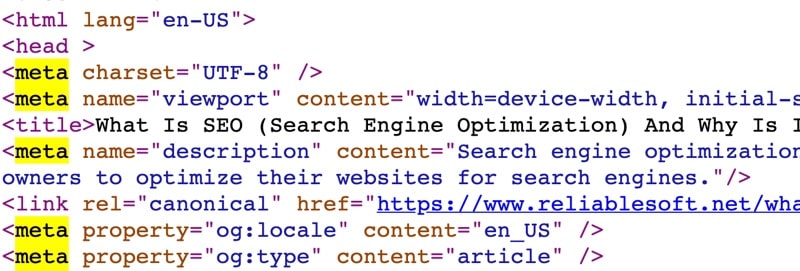
To view a page's meta keywords (or any other meta tag), open the page in a web browser, right-click, and select VIEW SOURCE CODE.
Locate the top part of the page that is enclosed in <head></head> tags and look for META.
Here is an example of the meta tags used by our What is SEO page.
Are Meta Keywords Still Relevant For SEO?
As you might have already guessed, having the keywords you wanted a page to rank in a meta tag makes it very easy to manipulate search algorithms. Soon enough, people started spamming search engines. The result is that the major search engines decided to drop meta keywords and remove them from their ranking process.
Here is where each major search engine stands, and what it has said publicly.
| Search engine | Uses meta keywords for ranking? | What they said |
|---|---|---|
| No | Stated in 2009: "Does Google ever use the keywords meta tag in its web search ranking? In a word, no." | |
| Bing | No | Confirmed in 2014 that it is not a ranking signal, and said stuffing it can be treated as a spam indicator |
| Yahoo | No | Stopped using it in 2009, when Yahoo Search was still its own index |
| Yandex | Yes | Its webmaster documentation lists keywords among the meta tags its bot takes into account, and says it "can influence the page's relevance to search queries" |
| Baidu | Unclear | Widely reported to read the tag, but Baidu has published nothing current confirming it. Treat it as unverified |
| DuckDuckGo | No | Takes its results largely from Bing, so Bing's position applies |
Which Search Engines Still Use Meta Keywords?
One does, on the record.
Yandex, the largest Russian search engine, lists keywords in its webmaster documentation among the meta tags its indexing bot takes into account, with the note that it "can influence the page's relevance to search queries". That is Yandex's own current documentation, not a third-party claim.
Baidu, the largest Chinese search engine, is often listed alongside it. We could not find current Baidu documentation that confirms this, and its published SEO guide has not been updated in years, so treat Baidu as unverified rather than as a second example.
Everything else you will read about niche engines using the tag traces back to these two claims.
Should You Remove Meta Keywords From Your Pages?
It depends on the case. If you care about organic traffic from Yandex and Baidu and you already have the meta keywords on your pages, then you can leave them.
If your main focus is Google traffic, you don’t need to add meta keywords for the sake of Yandex. It’s a very lightweight SEO signal that does not deserve too much attention.
There is one argument for actively removing them that has nothing to do with rankings. Your meta keywords are readable by anyone. A competitor who opens your source code gets your target keyword list for every page, handed over without them having to run a single tool. If you have spent real money on keyword research, publishing the results in your HTML is a strange way to protect it.
So the practical rule is: on a site that targets Google, leaving the tag in costs you nothing in ranking terms and gives away your keyword strategy. Taking it out costs you nothing either. If you are choosing, take it out.
Which Meta Tags Are Important For SEO?
I've mentioned above that other meta tags are still important for SEO. The most critical to use are:
- Title tag
- Meta Descriptions tag
- Meta Robots tag
1. Title Tag
The title tag has this format:
<title>What are meta tags and why they are important for SEO</title> and is one of the most critical SEO elements.
The title tag is essential for SEO because:
- Gives search engines a big clue as to what the page is about.
- It is shown in the search results (first line of the search snippet).
- It is shown as the tab title in browsers.
- It is shown as the title of a post when shared on social media networks.
For more on how the title tag works and how it differs from the heading on the page, read Page Title vs H1 Tag.
2. Meta Descriptions Tag
The meta description tag has this format:
<meta name="description" content="Meta keywords are not used by Google, Bing and Yahoo but they are taken into account by other search engines."/> and maybe shown as part of the search snippet in the SERPS (search engine results pages).
The meta description tag is important for SEO because:
- A compelling meta description tag will encourage users to click on your search snippet, resulting in more traffic and higher CTR (click-through rates).
- Search Snippets with a high CTR are more likely to appear in the results' top positions than snippets with a low CTR. This is an indirect SEO factor that has gained more importance in the last few years.
- Search engines tend to highlight search terms appearing in a meta description tag, which makes them more relevant to users and leads to more clicks.
Write one for every page, around 155 characters, describing what the page actually covers rather than repeating the title.
3. Meta Robots Tag
The meta robots meta tag has the following format:

It is used to instruct search engines on how a particular page should be treated when it comes to search.
The most important values are:
- index - Allow search engines to index a page and show it in the search results
- follow - Follow any external links found on the page
- noindex - Instruct search engines not to index the page and not to show it in the search results
- nofollow - Don't follow external links from this page
There are more values than these, and they can be combined.
The meta robots tag is important for SEO because a misconfiguration can prevent search engines from indexing a page, which means no rankings or traffic.
Optimizing the meta robots tag is part of technical SEO, the process of optimizing a website for the crawling and indexing phase.
Key Learnings
Meta keywords were a ranking signal for Google, Bing and Yahoo in the past, and none of them has used the tag for well over a decade. Yandex is the one major search engine that still documents it as something its bot reads.
If Yandex traffic matters to you, meta keywords are worth adding, done honestly and without stuffing. If it does not, the tag does nothing for you and quietly publishes your keyword list to anyone who looks.
Other meta tags are super important for SEO for ALL search engines.
So, as part of your on-page SEO optimization, pay special attention to your meta title tags, meta description tags, and meta robots tags.