

- The 10 Best Ecommerce Courses And Certifications In 2026
- How To Choose An Ecommerce Course
- Are Ecommerce Courses And Certifications Worth It?
- Ecommerce Certifications And Professional Programs
- Ecommerce Courses For Beginners
- Platform Courses: Shopify And Amazon
- Will AI Replace E-Commerce Jobs?
- How We Chose These Courses
- Learn More About Ecommerce

The best ecommerce course for you depends on where you are and where you sell. If you are a beginner, the Google Digital Marketing & E-commerce Certificate and the free Foundations course from Google give you the most structured start, and HubSpot's free course covers the marketing basics in under an hour. If you sell on a specific platform, Shopify Academy and Amazon Seller University are free and come straight from the platforms. If you already run a store and want to grow it, DigitalMarketer and Foundr go deeper into scaling. Costs range from free to $1,949.
| Course | Best For | Cost | Duration |
|---|---|---|---|
| Google Digital Marketing & E-commerce Certificate | Beginners who want a career credential | $49/month after a 7-day free trial | 6 months (10 hours a week) |
| Reliablesoft eCommerce SEO Course | Getting free search traffic to your store | $127 (21-course bundle) | 9 lessons |
| Ecommerce Marketing Mastery by DigitalMarketer | Store owners who want a certification | $495 | 6 modules, 40 video lessons |
| eCommerce Masters by Foundr | Scaling a store that already sells | Premium (price shown at checkout) | 9+ hours, 62 lessons |
| Digital Marketing Strategy and AI by Harvard Business School Online | Experienced professionals who want a strategic framework | $1,949 | 30-35 hours |
| Foundations of Digital Marketing and E-commerce by Google | A free introduction to ecommerce | Free to audit | About 11 hours |
| Ecommerce Marketing Course by HubSpot | A quick, free overview of ecommerce marketing | Free | 52 minutes |
| E-Commerce Essentials by Skillshare | Choosing a product and starting an online business | Skillshare membership (1 month free) | Short class |
| Shopify Academy | Building and running a Shopify store | Free | Short self-paced courses |
| Amazon Seller University | Selling on the Amazon marketplace | Free | Self-paced videos and guides |
Below you will find what each course covers, who it suits, what it costs, and where it falls short, followed by how to choose the right one and whether an ecommerce certification is worth it.
The 10 Best Ecommerce Courses And Certifications In 2026
- Google Digital Marketing & E-commerce Certificate
- Reliablesoft eCommerce SEO Course
- Ecommerce Marketing Mastery by DigitalMarketer
- eCommerce Masters by Foundr
- Digital Marketing Strategy and AI by Harvard Business School Online
- Foundations of Digital Marketing and E-commerce by Google (Free)
- Ecommerce Marketing Course by HubSpot (Free)
- E-Commerce Essentials by Skillshare
- Shopify Academy (Free)
- Amazon Seller University (Free)
How To Choose An Ecommerce Course
Start with three questions:
Are you a complete beginner or growing an existing store? - If you are new to ecommerce, start with a course that covers the basics in a logical order, like the Google certificate, the free Google Foundations course, or HubSpot. If you already run a store that makes sales, the advanced courses (DigitalMarketer and Foundr) will add more, because they assume you have products, traffic, and data to work with.
Do you sell on your own website or on a marketplace? - If you run your own store on Shopify, WooCommerce, or another platform, you need to learn how to bring traffic to it yourself: SEO, ads, and email. The Reliablesoft, Google, and HubSpot courses cover that, and Shopify Academy teaches the platform itself. If you sell on Amazon, most of your traffic comes from Amazon's own search, so Amazon Seller University is the most relevant place to start.
Do you want a free course or a certificate?
- Free: the Google Foundations course (free to audit), HubSpot, Shopify Academy, and Amazon Seller University.
- A certificate for your resume: the Google certificate, the Reliablesoft course (SEO and digital marketing certificates), DigitalMarketer, or Harvard Business School Online. Our list of digital marketing certifications covers more credentials.
- Growing your own business: Reliablesoft for search traffic, DigitalMarketer and Foundr for scaling, and the platform academies for the tools you use every day.
Are Ecommerce Courses And Certifications Worth It?
An ecommerce course is worth it if you use it to build or grow a real store, not just to collect a certificate. A course gives you the structure and the vocabulary, but the real learning happens when you launch products, run campaigns, and look at your own sales data.
What a good course gives you:
A structured path - Instead of piecing together blog posts and videos, you learn product research, store setup, traffic, conversion, and retention in a logical order.
Skills that transfer - SEO, email marketing, and paid ads work the same way whether you sell on Shopify, WooCommerce, or your own custom store.
Proof of your skills - If you are an aspiring ecommerce specialist, a certificate shows employers and clients that you have the foundations. Combine it with a store or a project you can point to and you have a strong case for a first job or client.
Before paying for an expensive course, check what it includes and whether there is a money-back guarantee. Most of the fundamentals are available for free, so paid courses should give you something more: depth, support, or a recognized credential.
Ecommerce Certifications And Professional Programs
1. Google Digital Marketing & E-commerce Certificate
- Best For: Beginners who want a career credential
- Duration: 6 months (10 hours per week)
- Cost: $49/month after a 7-day free trial
- Certificate: Yes
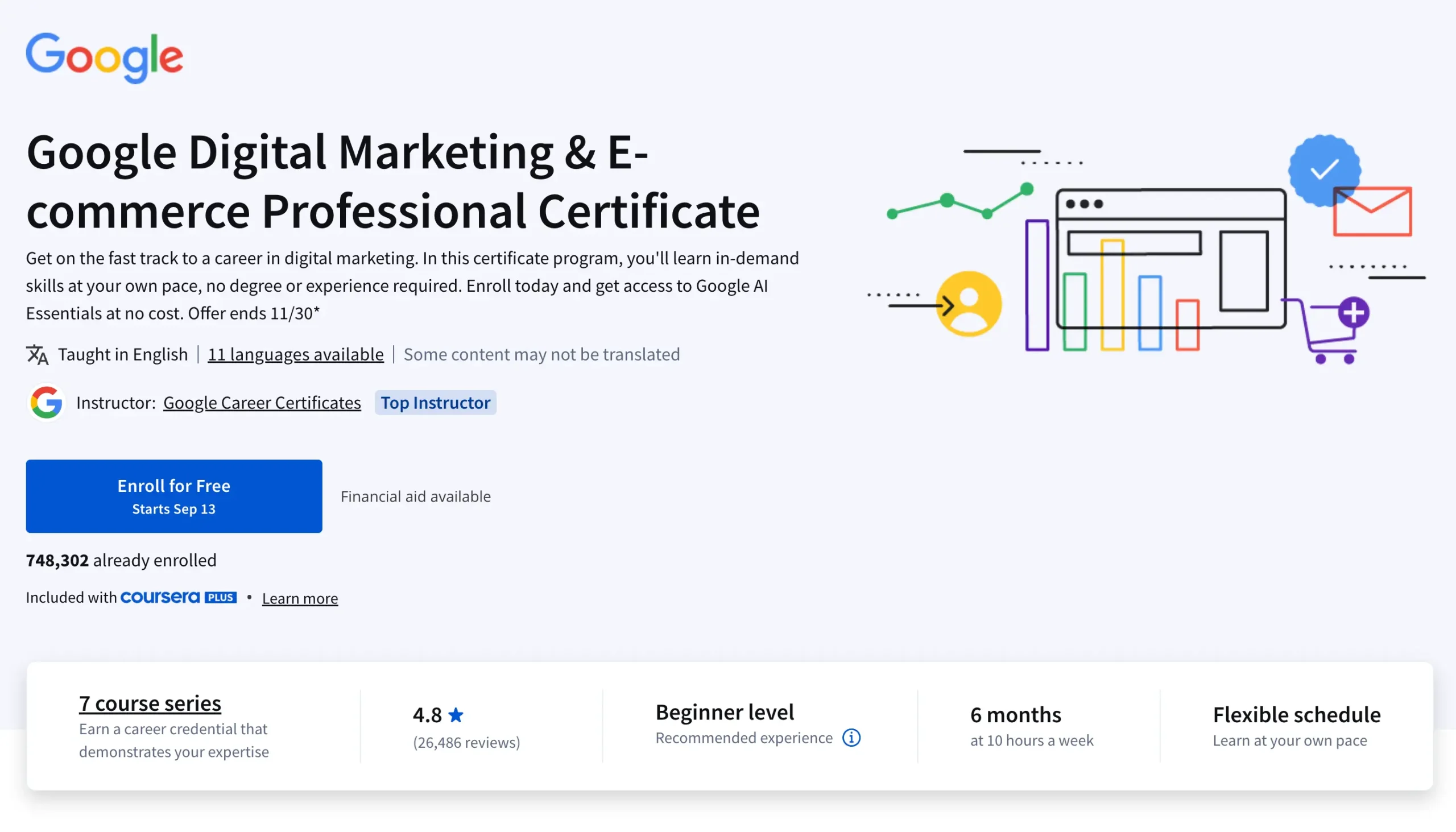
The Google Digital Marketing & E-commerce Professional Certificate is the most popular ecommerce certificate online. More than 1.5 million learners have enrolled, and it has a 4.8 out of 5 rating on Coursera. It is designed for complete beginners, so you don’t need a degree or any experience to start.
It is an 8-course series covering the following topics:
- Foundations of Digital Marketing and E-commerce
- Attract and Engage Customers with Digital Marketing
- From Likes to Leads: Interact with Customers Online
- Think Outside the Inbox: Email Marketing
- Assess for Success: Marketing Analytics and Measurement
- Make the Sale: Build, Launch, and Manage E-commerce Stores
- Satisfaction Guaranteed: Develop Customer Loyalty Online
- Accelerate Your Job Search with AI
Why Enroll In This Course?
The certificate teaches the full path from attracting customers to making the sale and keeping customers coming back. The Make the Sale course covers how to build, launch, and manage an online store, and you finish the program with projects you can add to your portfolio.
Because you pay a monthly subscription, the total cost depends on how fast you finish. At the suggested pace of 10 hours a week, it takes about 6 months, so budget up to about $300.
Read our Google Digital Marketing & E-commerce Certificate review for what each course covers and what the exams look like.
Where it falls short: most of the program is general digital marketing. Only one of the eight courses is about running an online store, so if you already know marketing, a platform or scaling course will teach you more.
2. Reliablesoft eCommerce SEO Course
- Best For: Getting free search traffic to your store
- Duration: 9 lessons
- Cost: $127 (includes the 21-course Digital Marketing Full Course)
- Certificate: Yes (SEO and Digital Marketing certificates)
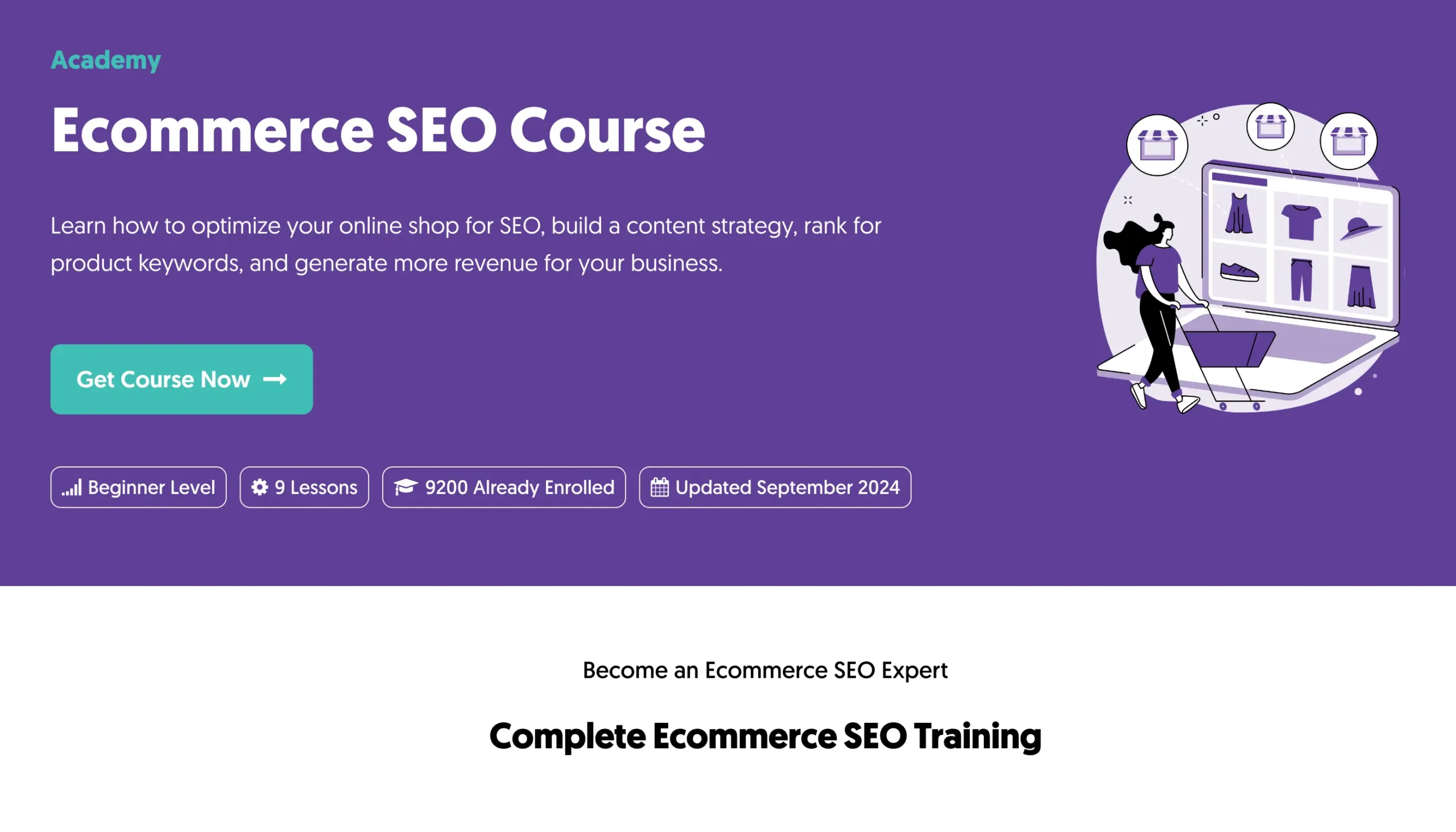
The eCommerce SEO Course by Reliablesoft Academy teaches you how to optimize your online store for search engines, so you can get customers from Google without paying for every click.
The course has 9 lessons covering the following topics:
- eCommerce SEO for beginners
- Keyword research for eCommerce websites
- How to SEO your shop’s site structure
- How to SEO your shop’s homepage
- How to optimize your category pages
- How to SEO your product pages
- How to use blogging to get targeted traffic to your store
- How to build links to your product pages
Why Enroll In This Course?
If you rely on advertising alone, your costs stay high and your margins stay low. The techniques in this course help you grow organic traffic to your store, and the advice applies to all the major platforms, including Shopify, WooCommerce, and BigCommerce.
The course is part of the Digital Marketing Full Course, so you also get 20 other courses, including Google Ads and Facebook Ads, to build a complete ecommerce marketing strategy. You get free lifetime updates and a 60-day money-back guarantee.
Where it falls short: it focuses on SEO. It won’t teach you how to choose products or set up a store, so pair it with a beginner or platform course if you are starting from zero.
3. Ecommerce Marketing Mastery by DigitalMarketer
- Best For: Store owners who want a certification
- Duration: 6 modules, 40 video lessons (self-paced)
- Cost: $495
- Certificate: Yes
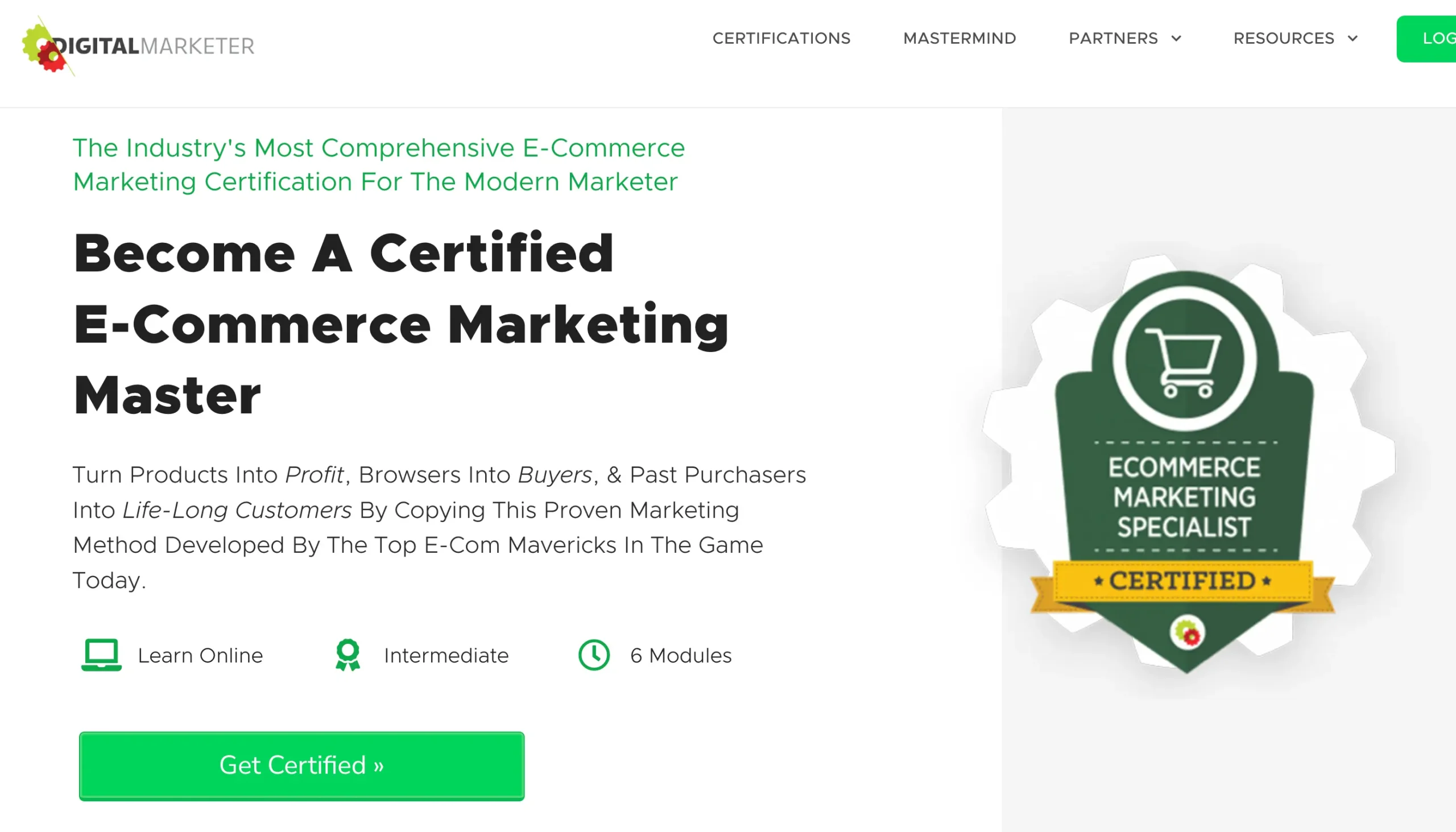
Ecommerce Marketing Mastery by DigitalMarketer is a certification course for ecommerce marketers and store owners who want to grow beyond their first sales. It is aimed at people who already have a store and want to scale it.
The course includes:
- 6 core modules with 40 video lessons
- 11 handouts, including a product page audit, a Facebook ad worksheet, and a growth scorecard template
- 5 quizzes and a final exam
The first module starts with the core concepts: validating your product with DigitalMarketer’s Ecommerce Tree of Life, evaluating product-market fit, and mapping the customer value journey for ecommerce.
Why Enroll In This Course?
It gives you a step-by-step framework for growing an ecommerce store, taught by agency owners and store operators, with worksheets you can apply straight to your own store. When you pass the final exam, you become a Certified Ecommerce Marketing Strategist and get a printable certificate and a badge for your website, email signature, and LinkedIn profile.
Where it falls short: it isn’t for complete beginners, and at $495 it costs more than most of the other options on this list.
4. eCommerce Masters by Foundr
- Best For: Scaling a store that already sells
- Duration: 9+ hours (5 modules, 62 video lessons)
- Cost: Premium (price shown at checkout)
- Certificate: Yes (Foundr digital certificate)
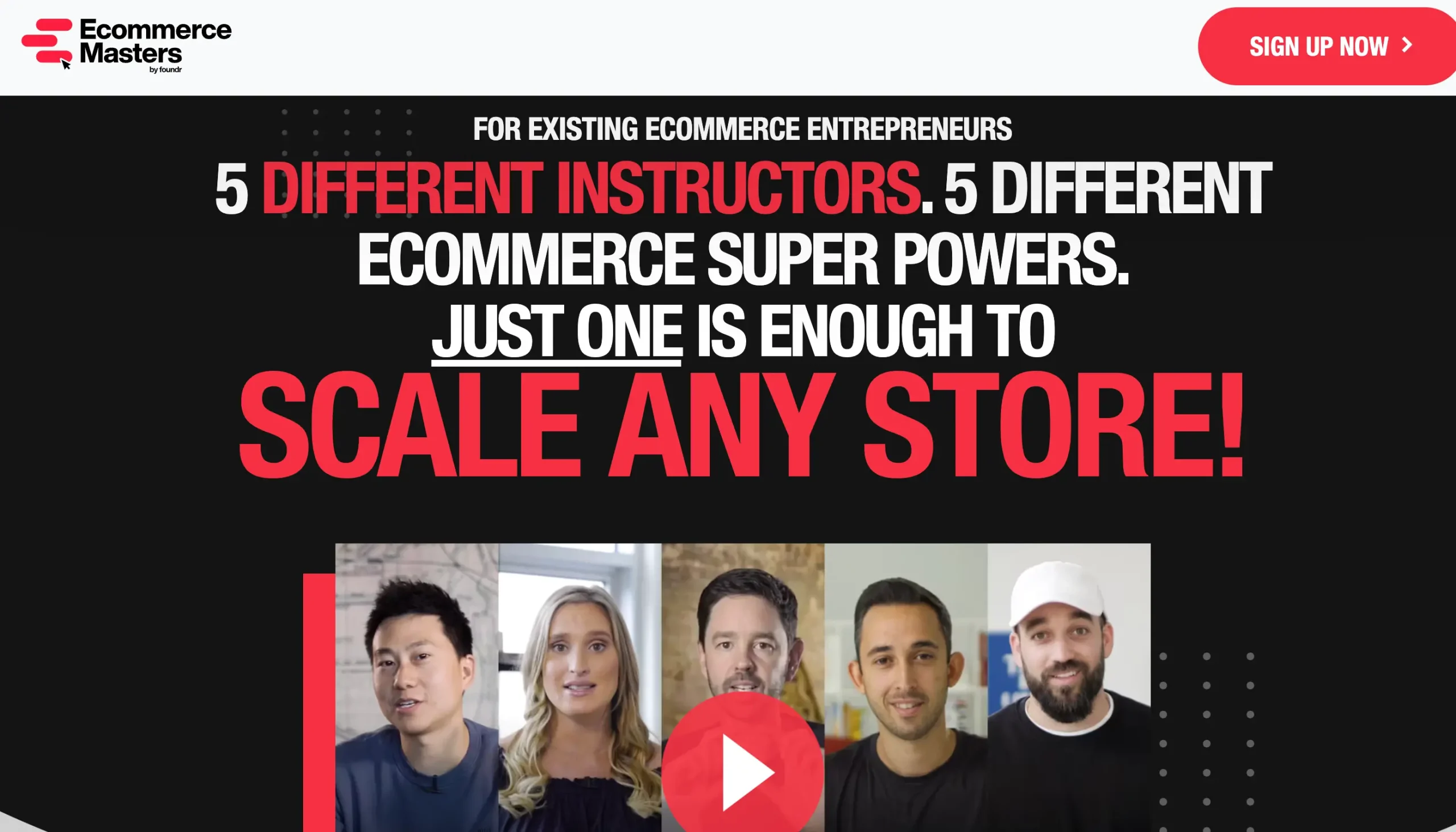
eCommerce Masters by Foundr is an advanced course for store owners who already have sales and want to scale. Five instructors, each a founder or marketer who has grown ecommerce brands, teach one module each.
The course covers the following topics:
- Facebook ads for ecommerce
- Product manufacturing and sourcing
- Scaling with advanced operations
- Influencer marketing
- Email marketing
Why Enroll In This Course?
Each module is a practical playbook from someone who has done it, with a workbook and on-screen software demonstrations. You also get access to a private community of other ecommerce founders.
Where it falls short: Foundr is clear that the course is for existing store owners, so it isn’t a good fit if you haven’t made your first sales. The price isn’t shown until checkout.
5. Digital Marketing Strategy and AI by Harvard Business School Online
- Best For: Experienced professionals who want a strategic framework
- Duration: 30-35 hours (6 modules)
- Cost: $1,949
- Certificate: Yes (Certificate of Completion)
Digital Marketing Strategy and AI by Harvard Business School Online is taught by Professor Sunil Gupta. It teaches you how to plan a data-driven digital marketing strategy and how AI is changing the way companies acquire and keep customers.
The 6 modules cover:
- Marketing Strategy in the AI Era
- Crafting a Digital Marketing Plan
- Acquiring Customers, Part 1: Paid Media
- Acquiring Customers, Part II: Owned and Earned Media in the AI Era
- Engaging Customers
- Allocating Budget and Measuring Success
Why Enroll In This Course?
If you manage marketing for an ecommerce business rather than running campaigns yourself, this course gives you the strategic frameworks: how to plan, where to spend, and how to measure what works. A Harvard Business School credential also carries weight on a resume.
Where it falls short: it is not ecommerce-specific (there is no module on running an online store), and at $1,949 it is by far the most expensive option on this list.
Ecommerce Courses For Beginners
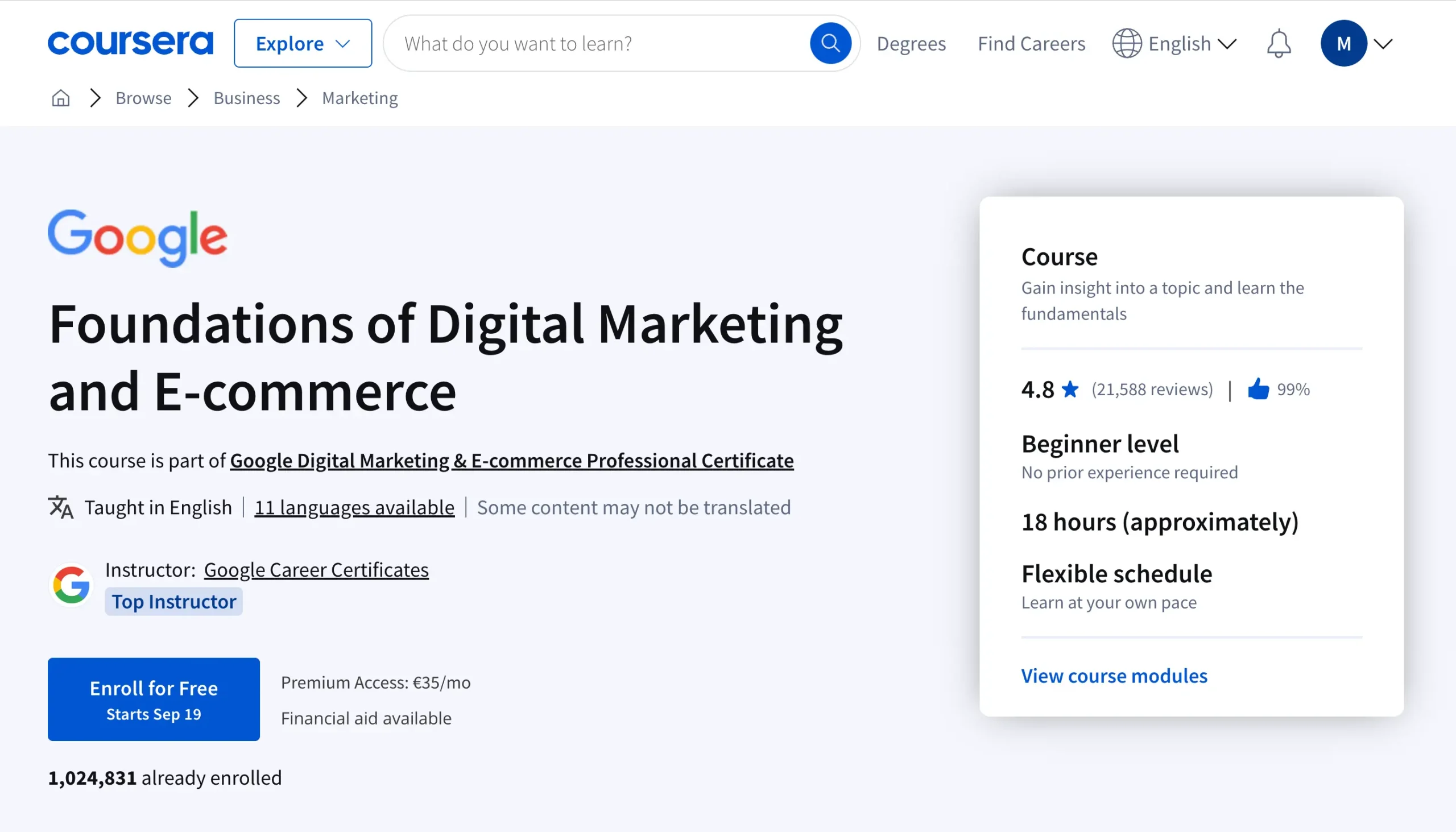
6. Foundations of Digital Marketing and E-commerce by Google (Free)
- Best For: A free introduction to ecommerce
- Duration: About 11 hours
- Cost: Free to audit (certificate with a Coursera subscription)
- Certificate: Yes, if you pay
Foundations of Digital Marketing and E-commerce is the first course of the Google certificate above, and you can take it on its own. It has a 4.8 out of 5 rating from more than 30,000 reviews.
The course has 4 modules:
- Introduction to foundations of digital marketing and e-commerce
- The customer journey and the marketing funnel
- Digital marketing and e-commerce strategy
- Measure performance success
Why Enroll In This Course?
It is the easiest way to find out whether ecommerce is for you without paying anything. You can audit the course for free, and if you decide to continue, your progress counts toward the full Google certificate.
Where it falls short: the free audit doesn’t include a certificate or graded assignments, and it is an introduction, so you won’t build a store in this course.
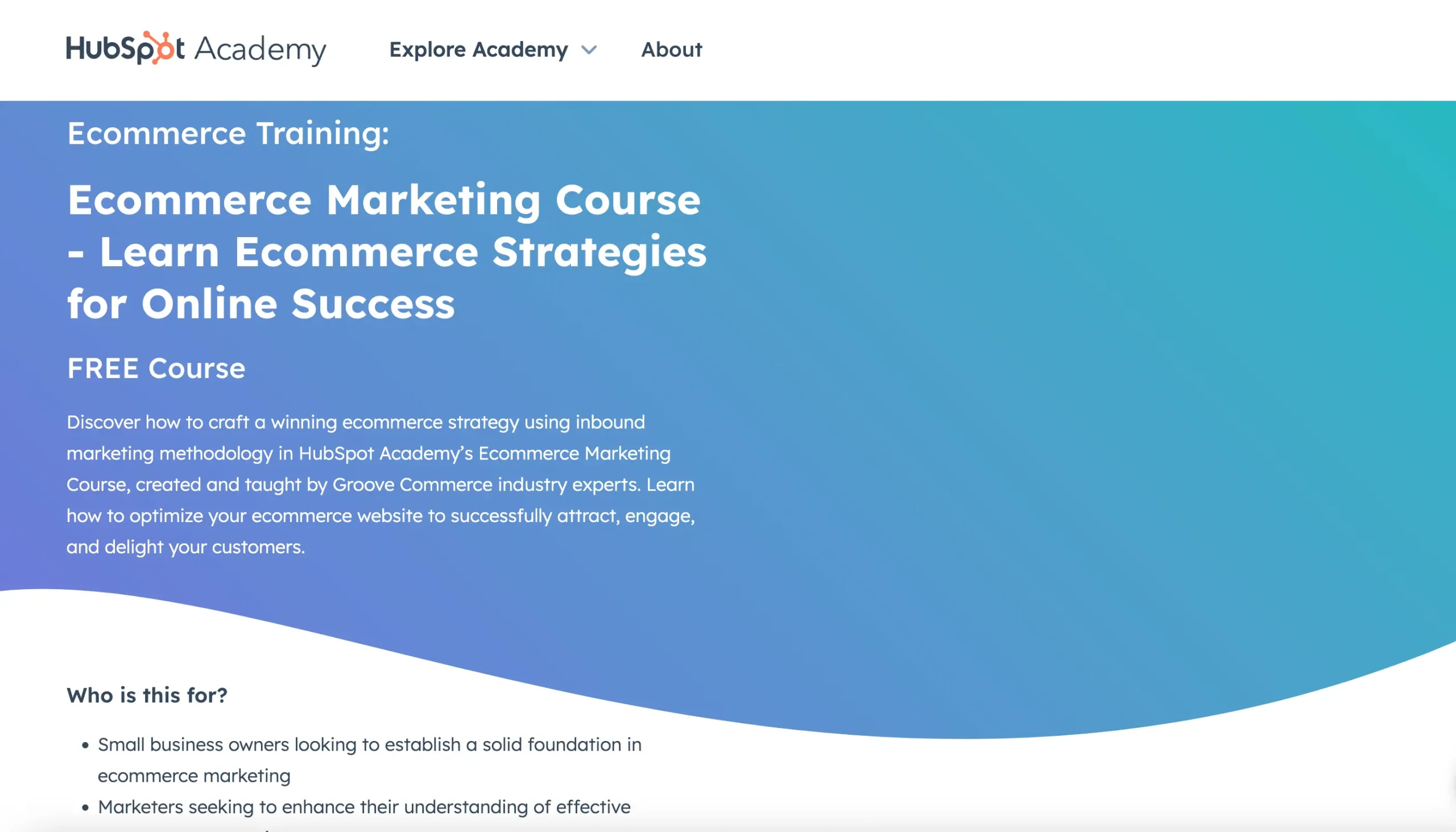
7. Ecommerce Marketing Course by HubSpot (Free)
- Best For: A quick, free overview of ecommerce marketing
- Duration: 52 minutes (5 lessons, 10 videos, 3 quizzes)
- Cost: Free
- Certificate: No
HubSpot’s Ecommerce Marketing Course teaches you how to use inbound marketing to attract qualified traffic, increase conversions, and keep customers engaged.
It includes the following lessons:
- Introduction to Ecommerce Inbound Marketing
- Getting Started With Your Ecommerce Inbound Marketing Plan
- Creating Your Ecommerce Inbound Marketing Strategy
- The HubSpot-Built Integration for Shopify
- Ecommerce Marketing Course Next Steps
Why Enroll In This Course?
It is short, free, and practical. In under an hour, you get a clear plan for attracting and converting customers, which is a good starting point before committing to a longer course.
Where it falls short: there is no certificate, and part of the course is about connecting Shopify with HubSpot’s own software.
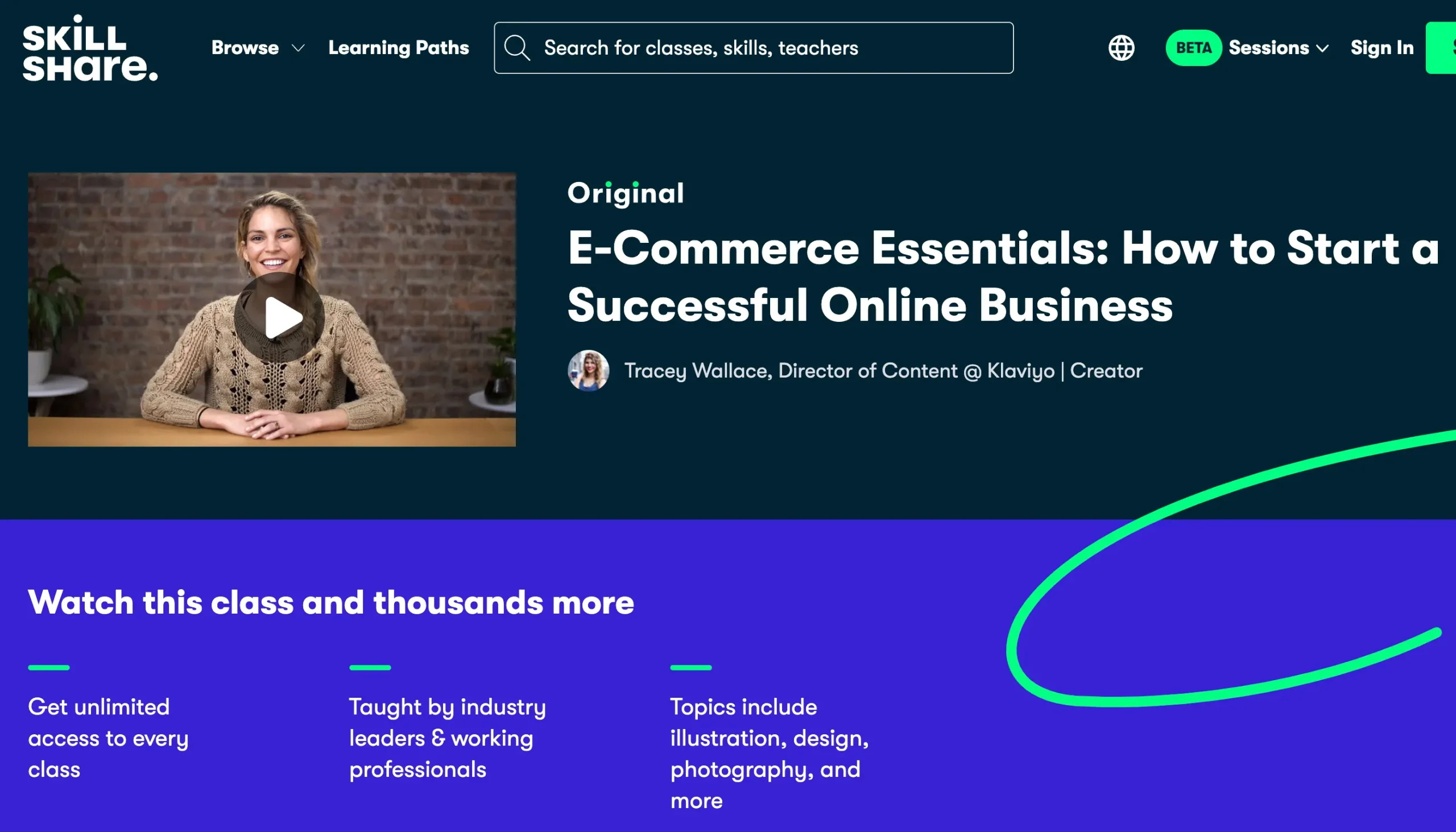
8. E-Commerce Essentials by Skillshare
- Best For: Choosing a product and starting an online business
- Duration: Short class
- Cost: Skillshare membership (1 month free with our link)
- Certificate: Certificate of completion
E-Commerce Essentials: How to Start a Successful Online Business is a Skillshare class by Tracey Wallace that takes new entrepreneurs through the first steps of selling online.
The class teaches you:
- How to choose a product to sell
- How to identify your competition
- Which platform to sell your product on
- How to start a content marketing strategy
Why Enroll In This Course?
It is a quick, practical way to go from an idea to a plan, and your Skillshare membership also gives you access to thousands of other classes.
Where it falls short: it covers the very beginning of the journey only. You’ll need another course to learn how to market the store once it is live.
Platform Courses: Shopify And Amazon
9. Shopify Academy (Free)
- Best For: Building and running a Shopify store
- Duration: Short self-paced courses (many take about 20 minutes)
- Cost: Free
- Certificate: Shopify Verified Skills credentials are available
Shopify Academy is Shopify’s own learning platform. Its free courses teach you how the platform works, straight from the company that builds it.
Good courses to start with include:
- Introduction to Shopify
- Navigating the Shopify Admin
- Strategic Merchandising for Ecommerce
Why Enroll In This Course?
If you have chosen Shopify, this is the most accurate and up-to-date place to learn it. The courses use interactive demos of the Shopify admin, and Shopify also offers Verified Skills credentials if you want to prove your platform knowledge.
Where it falls short: it teaches the platform, not the marketing. To bring customers to your store, combine it with an SEO, ads, or email course.
10. Amazon Seller University (Free)
- Best For: Selling on the Amazon marketplace
- Duration: Self-paced videos, webinars, and guides
- Cost: Free
- Certificate: No
Amazon Seller University is Amazon’s free learning hub for sellers. It covers everything from opening a seller account to growing a brand on Amazon.
It covers the following topics:
- Getting started as a seller
- Creating product listings and detail pages
- Fulfillment options, including Fulfillment by Amazon (FBA)
- Advertising and brand building
- Inventory management and pricing
Why Enroll In This Course?
If you plan to sell on Amazon, learn the rules and tools from Amazon itself before you pay for a third-party course. It is free and organized by skill level, from beginners to established brands.
Where it falls short: it only covers Amazon. It won’t help you build your own store or bring traffic from outside the marketplace.
Will AI Replace E-Commerce Jobs?
AI is changing how ecommerce work gets done, not whether it is needed. Tools can now write product descriptions, generate ad variations, answer customer questions, and analyze sales data, which takes over many repetitive tasks.
What AI doesn’t replace is the judgment behind them: choosing what to sell, understanding your customers, setting prices, and deciding where to spend your marketing budget. The courses are adapting too. Google added an AI job-search course to its certificate, and Harvard’s digital marketing course now teaches strategy for the AI era.
The practical takeaway is to learn the fundamentals and learn to use AI tools alongside them. That combination is what employers and clients look for.
How We Chose These Courses
We looked for courses that teach practical skills you can apply to a real store, from providers with a track record: Google, HubSpot, Harvard Business School Online, and the platforms themselves, plus specialist ecommerce trainers.
We checked every course on the provider’s own page for its current price, length, and certificate, and removed courses that have been retired. We included free and paid options, and beginner and advanced courses, so there is a good choice at every level and budget.
The review was done by an ecommerce marketer with decades of experience in the field.